
Wholesale Panel Supply: Planning Monthly Volumes with a Mill
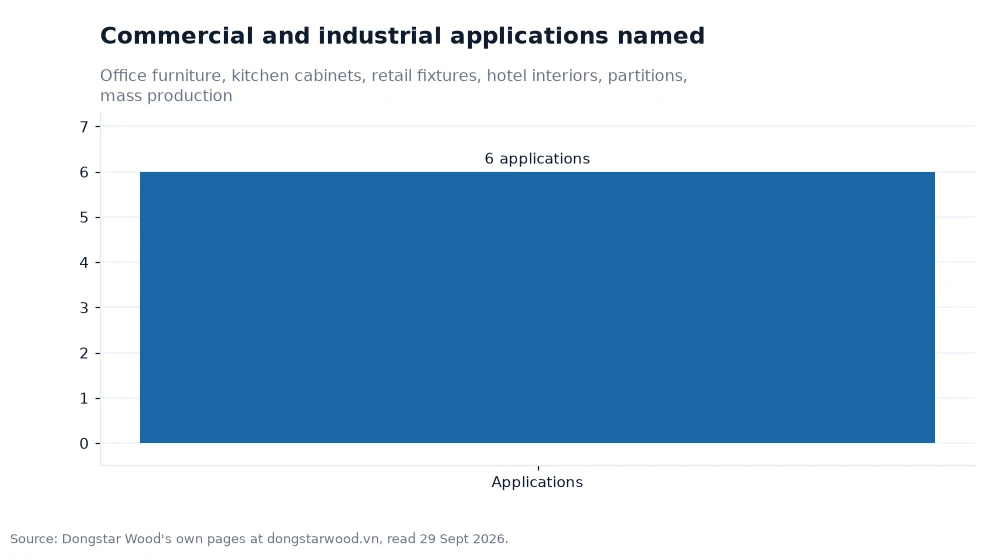
Wholesale panel supply is a volume conversation: the buyer brings a monthly requirement and the mill brings a production rhythm. Dongstar Wood names six commercial applications for its panels — office furniture, kitchen cabinets, retail display fixtures, hotel interiors, partition systems and mass-production furniture manufacturing — and each one maps onto a published thickness and glue grade.

Key takeaways
- The commercial range covers furniture plywood, hardwood plywood and veneer plywood under one supply programme.
- Face veneers run birch, pine, bleached poplar, EV and rose eucalyptus; cores include Acacia Core, Bodhi Core, Eucalyptus Core and Combi Core.
- Thickness guidance splits three ways: 6–9 mm for cabinet backs, 12–15 mm for office furniture and 18 mm for heavy-duty work.
- MR glue suits dry interiors and BWR covers humidity; shipments to the EU and US carry no anti-dumping tax.
What wholesale panel supply covers
A wholesale programme is more than a price list. The manufacturer positions itself as a Vietnam plywood maker specialising in furniture plywood, hardwood plywood and veneer plywood, with OEM and custom plywood solutions alongside standard ranges. For a buyer planning monthly volumes, that combination matters: standard lines give predictable availability, while the custom option absorbs the sizes a production programme needs.
The supply side of the programme is published rather than negotiated. 16+ automated production lines, a factory of 48,000 m² and monthly supply capacity above 100 × 40ft describe a rhythm a buyer can plan against. A mill that publishes its rhythm lets the buyer do arithmetic before the first container, which is the difference between a schedule and a hope.
Face veneers and core options
The face veneer is the visible half of the specification and the core is the structural half. Faces run birch, pine, bleached poplar, EV and rose eucalyptus; cores include Acacia Core, Bodhi Core, Eucalyptus Core and Combi Core. The pairing is where a wholesale order gets its character: a birch face over an Acacia Core reads as a furniture panel, while a pine face over a Combi Core reads as a cost-conscious interior panel.
The client's own descriptions help a buyer shortlist pairings. Acacia Core is presented as a dense, high-strength hardwood with superior load-bearing capacity; White Hardwood Core, covering species like Bodhi, is described as stable with balanced mechanical strength and cost-performance; Eucalyptus Core is described as maximum strength with high compression resistance. Choosing the pairing in the order rather than discovering it in the container makes a monthly volume easier to place.
Thickness guidance by application
The published thickness guidance splits the range into three bands. Panels of 6–9 mm suit cabinet backs, drawer bottoms and partitions; 12–15 mm covers office furniture, shelves and hotel fixtures; 18 mm carries heavy-duty furniture, worktops and structural panels. Contractors often standardise 12 mm and 18 mm, which means those two thicknesses are the ones a wholesale programme can most reliably keep running on the line.
Standardisation is the quiet lever in volume planning. A buyer who writes 12 mm and 18 mm into a monthly requirement is ordering the thicknesses a mill can press without changing setups, and the saving shows up in scheduling rather than in the unit price. The guidance exists so that the specification can be matched to the application before the quotation is requested.
Glue grades for interior work
Interior work splits by moisture exposure. MR, moisture resistant, suits dry interiors; BWR, boiling water resistant, covers humidity and light water exposure. The distinction is not academic: a partition system in a hotel corridor and a cabinet in a kitchen see very different conditions, and the glue grade is what keeps the veneer bonded across both.
The broader adhesive catalogue — E0, E1, E2, MR, WBP and Phenolic Dynea — means a wholesale order can mix grades across a programme. Dry-interior lines run on the emission-controlled grades while formwork lines run on the phenolic systems, and a mill that holds the full catalogue can supply both from one production plan.
Six reasons European buyers name
The manufacturer lists six reasons European buyers should take notice: pricing lower than Chinese factories; reliable monthly output; robust quality control at each production stage; custom size, core structure, glue, face veneer and grade; competitive rates for EU wholesale distribution; and flexible minimum order quantities with fast delivery to Europe.
Two of those reasons are operational rather than commercial. Stable monthly supply and strong quality control at each stage are the pair that protects a programme: the first keeps the rhythm the buyer planned against, and the second keeps the panels within the tolerance the furniture line expects. The commercial reasons matter at the negotiation; the operational ones matter at the delivery.
Planning a monthly volume with the mill
A monthly volume is written as a matrix before it is written as an order: application, face, core, thickness, glue and quantity per line. The application list — office furniture, kitchen cabinets, retail display fixtures, hotel interiors, partition systems and mass-production furniture manufacturing — gives the matrix its rows, and the published thickness bands give it its columns. A buyer who arrives with a matrix can get a quotation that is already mostly specified.
The duty position closes the plan. A No Anti-Dumping Tax position is published for EU and US shipments, and for a European wholesale programme that position forms part of the landed cost rather than a footnote. Planning the volume, the specification and the duty treatment together is what converts a monthly requirement into a schedulable programme.
| Thickness band | Applications named | Planning note |
|---|---|---|
| 6–9 mm | Cabinet backs, drawer bottoms, partitions | Interior panels behind visible surfaces |
| 12–15 mm | Office furniture, shelves, hotel fixtures | The standardisation band for contractors |
| 18 mm | Heavy-duty furniture, worktops, structural panels | The structural choice for load-bearing parts |
Worked example: a monthly matrix in square metres
Convert the matrix into area before requesting a quotation. A 1250 × 2500 mm panel covers 3.125 m², so a monthly line of 240 sheets is 240 × 3.125 = 750 m² of panel. That single conversion lets the buyer compare the requirement with the mill's published rhythm: 750 m² is a planning number, not a production mystery.
Add the second format and the picture sharpens. A 1220 × 2440 mm panel is 1.22 m × 2.44 m = 2.98 m², so the same 240 sheets in the smaller format is 240 × 2.98 = 715.2 m². The 34.8 m² difference per month is the kind of figure that decides which format a furniture line standardises on.
Frequently asked questions
Which applications does the commercial range cover?
Office furniture, kitchen cabinets, retail display fixtures, hotel interiors, partition systems and mass-production furniture manufacturing. Each application maps onto a published thickness band, so a monthly requirement can be written as a matrix of applications and thicknesses.
How do MR and BWR glue grades differ?
MR is moisture resistant and suits dry interiors; BWR is boiling water resistant and covers humidity and light water exposure. The grade is chosen from the conditions the panel will meet, not from the price list.
Which thicknesses do contractors standardise?
Contractors often standardise 12 mm and 18 mm. Those two bands sit in the middle of the published guidance and can be kept in production without constant setup changes.
From matrix to monthly programme
A monthly volume becomes a programme when the matrix is agreed and the rhythm is confirmed. Commercial Plywood from this range covers furniture, hardwood and veneer applications under one supply plan. Check the birch plywood page for the face veneer options that anchor furniture lines, and the okoume plywood page for the lighter interior panels that fill out a fit-out. A buyer who plans the matrix against the published range tends to find the quotation comes back already shaped like the order.
This article relies on numbers published by Dongstar Wood's product listings examined 29 Sept 2026[1].