
A refillable perfume project is not a standard bottle order with a nicer cap. The shell has to survive several open-and-close cycles, the refill has to be filled and sealed as its own unit, and the guarantee you give the consumer runs far longer than the shelf life of a single bottle. Because of that, the first thing to establish with a manufacturing partner is not the price per unit but the service scope: who does the shell, who fills the refill, who assembles and tests the mechanism, and who holds the documentation.
Key takeaways
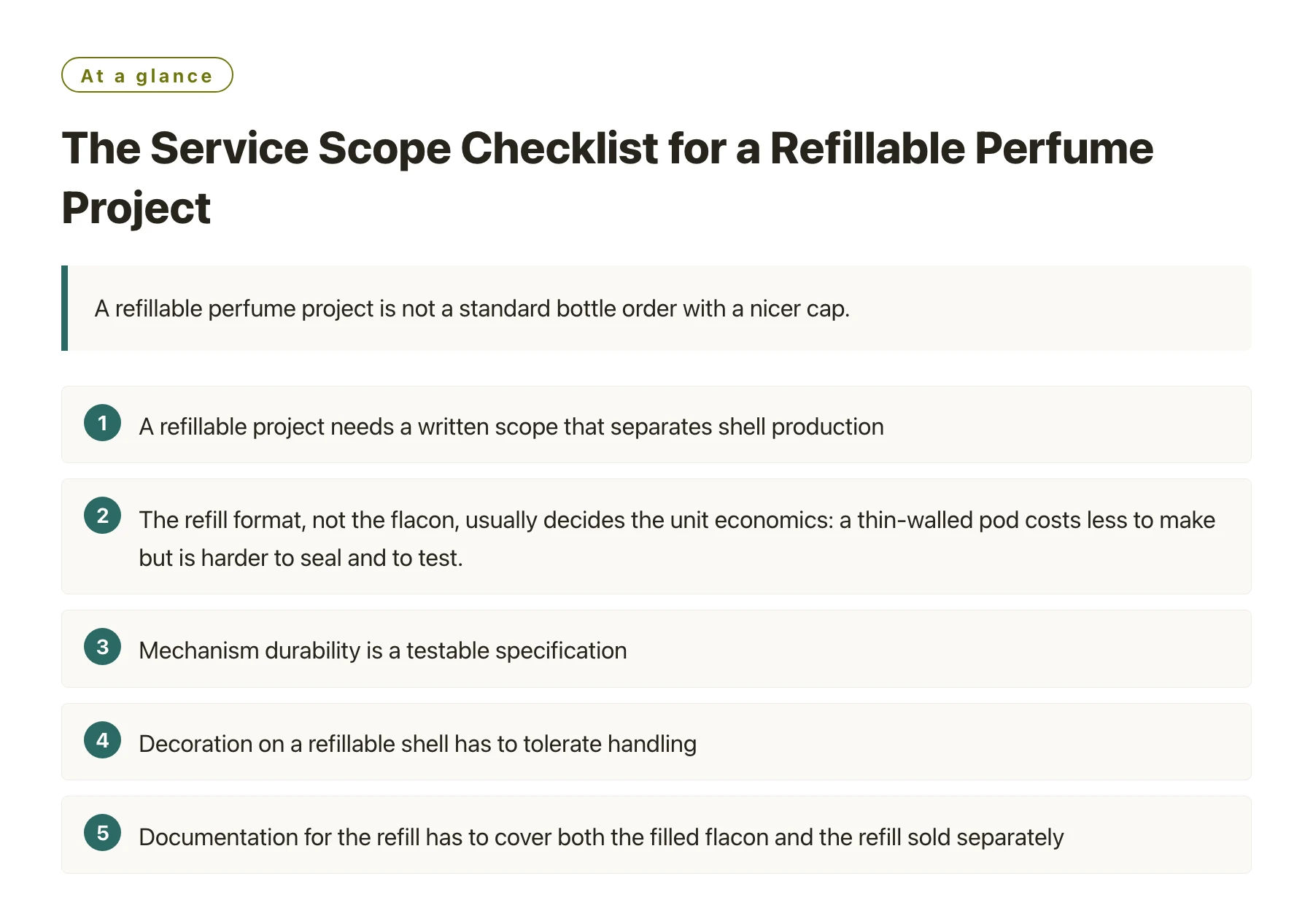
- A refillable project needs a written scope that separates shell production, refill filling, final assembly and mechanism testing, because each one can sit with a different supplier.
- The refill format, not the flacon, usually decides the unit economics: a thin-walled pod costs less to make but is harder to seal and to test.
- Mechanism durability is a testable specification, so ask for a cycle count and the pass criteria before tooling is cut.
- Decoration on a refillable shell has to tolerate handling, alcohol contact and cleaning, which rules out some finishes that are fine on a single-use bottle.
- Documentation for the refill has to cover both the filled flacon and the refill sold separately, because in several markets they are placed on the market as separate items.
Refillable fragrance has moved from a niche sustainability statement to a normal line extension. Buyers ask for it because it lowers the cost of the second purchase and keeps a signature bottle on the customer's shelf, while European packaging rules push design in the same direction. What is less often discussed is how much of the project's difficulty sits in manufacturing scope rather than in the scent.
Most of the problems that show up in a refillable launch are scope problems in disguise: nobody agreed who tests the pump, what happens to shells that fail decoration after the refill line is already running, or which party holds the artwork files for the refill label. Those are settled with one document written before tooling, not after.
This checklist is the version worth taking into a first meeting with a manufacturer.
Start by splitting the project into four scopes
A refillable product is really four manufacturing jobs stacked on top of each other, and they do not have to sit with the same company. Treating them as one line item on a quotation is the fastest way to lose track of responsibility.
Write each scope down separately, with the party responsible for it, even if the answer for all four is the same factory. The exercise takes twenty minutes and it prevents the most common dispute in this category: a refill that fits the flacon perfectly in the lab and leaks in the retail box.
Scope one: the primary shell
The shell is the reusable object, so its material and wall thickness are chosen for repeated handling rather than for minimum cost. Ask whether the mould is new or adapted from an existing one, because an adapted mould shortens tooling time but constrains the shape.
A perfume OEM manufacturer in China that keeps shell, pump and refill in one facility removes a common source of dimensional mismatch, because the parts are measured against each other on the same equipment. Where the parts come from different suppliers, ask for a fit check on assembled units rather than on individual components.
Scope two: the refill unit
The refill is a separate product with its own filling, sealing and labelling steps. Decide early whether it is sold pre-filled or as a concentrate the customer dilutes, because the second option pulls in a different set of labelling and safety questions.
Ask what fill tolerance the manufacturer can hold on the refill line. A refill that carries less than the stated amount is a consumer complaint; one that carries slightly more is a cost leak. Fix the tolerance in the specification rather than leaving it to the line.
Scope three: final assembly and mechanism
Assembly is where a refillable format earns or loses its reputation. The collar, the pump, the cap and the refill have to work as a system, and the mechanism has to be operable by a customer who has not read the instructions.
Ask for a cycle count with a stated pass criterion, and ask who runs the test. A number without a method is not a specification, and a method without an agreed pass threshold is not a decision.
Scope four: the documentation pack
The fourth scope is paper, and it is the one most often left until the end. Ask which documents come with the shipment, which are issued per batch, and which have to be requested separately, so that nothing is discovered missing when the goods are already at the port.
The scope sheet, filled in for a refillable launch
| Scope | What to agree | Where refillable differs | Who usually holds it |
|---|---|---|---|
| Shell production | Mould ownership, wall thickness, colour and finish | Thicker walls and a serviceable surface, because the object is reused | The shell manufacturer |
| Refill unit | Pod format, fill tolerance, sealing method, unit label | A second SKU with its own artwork and its own regulatory identity | The filling partner |
| Assembly | Collar, pump, cap and pod compatibility check on assembled units | Not optional; the mechanism is the product promise | The assembler |
| Mechanism testing | Cycle count, force to open and close, leak test method | Applied to a sample drawn from production, not only to prototypes | The assembler, witnessed by the brand |
| Decoration | Method, adhesion standard, resistance to alcohol and handling | Finishes that survive repeated contact, not one retail display | The decorator |
| Documentation | Batch records, safety documents, artwork files, recycling data | Covers both the filled flacon and the refill sold separately | Split, by written agreement |
The last column is the one to fill in first. If two scopes land on the same company, lead time usually improves; if several parties are involved, add a written interface check where the parts meet.
A refillable format moves the risk from the factory to the relationship. A single-use bottle is judged once, at delivery. A refillable one is judged every time a customer opens it, which means the warranty period you publish becomes a manufacturing specification. Before signing, ask the partner what they expect to happen when a shell fails in month eight — and get the answer in writing.
Questions that separate a real refill capability from a willing one
Plenty of factories will quote a refillable project. Fewer have run one through a full decoration and assembly cycle and then tested the result. The difference shows up in how specific the answers are.
Ask these in the same conversation as the quotation. Answers that stay general are not lies; they usually mean the process has not been run enough times to have a standard answer yet, which is useful to know before you commit tooling money.
What fails first on your line
A partner with real experience will name the step that causes most rework — frequently decoration adhesion on the shell, or a collar that will not seat after the refill is inserted. A partner who has not run the format will describe the process in the order it appears in a brochure.
How do you handle a decoration failure after filling
Because the shell is the expensive part, a decoration defect discovered after assembly has a different cost profile from a defect caught before it. Ask whether shells are inspected before filling happens, and what happens to the ones that fail after.
What does the refill inherit from the flacon
Some markets treat a refill as the same product in new packaging, others treat it as a separate placement. The documentation burden is not identical, and a supplier who exports regularly will already know which of its markets behave which way. Confirm the answer for your own market rather than assuming it transfers.
Where does the fragrance development sit
If the brand brings a formula, the manufacturing scope is production and filling. If the brief starts as a description, scent development is a fifth scope with its own timeline and its own approval gate. Refillable projects often begin as a packaging decision and only later discover that the scent has to be reformulated to sit well in the pod — work through Xuelei before the second round of quotations.
Ordering the work so nothing is decided twice
- Fix the refill format firstPod, cartridge or top-up bottle decides the filling line, the seal and much of the unit cost, so it has to be settled before the shell is drawn.
- Draw the shell against the refillDesigning the flacon first and finding a refill to fit it later is the single most expensive sequencing mistake in this category.
- Agree the decoration method and its testPick the finish and the adhesion test in the same meeting, because some finishes cannot pass the test the brand would want to publish.
- Run the mechanism test on production partsPrototypes made by hand are not evidence. Take the sample from the first production run and test it with the method already agreed.
- Freeze the artwork for both SKUsThe refill needs its own label, its own declarations and its own barcode. Treat it as a product, not as an accessory.
- Write the after-sales positionDecide in advance what the brand does when a customer reports a failed shell, and agree how the manufacturer supports that.
Cost drivers you can actually influence
Refillable packaging carries a higher first-unit cost than a single-use bottle, and most of that premium is structural rather than decorative. The shell is thicker, the mechanism is a separate assembly, and the refill adds a second set of materials and a second label.
The controllable part is the number of parts. Every additional component — an inner liner, a decorative collar, a separate cap insert — adds a fitting step, a tolerance to hold and a way for the product to fail. Buyers who cut part count early usually end up with a cheaper and more reliable refillable product than buyers who cut decoration.
Where the money is recoverable
Some of the premium returns through the refill itself: less glass or plastic per repeat purchase, less shipping weight, and a lower decoration cost because the shell is not redecorated every time. Packaging rules in the EU increasingly reward design for recyclability and reuse, which is one reason this format keeps growing [1]. Those returns depend on the refill being cheaper than the original purchase in the customer's eyes, so pricing has to be designed alongside the packaging, not after it.
Where it is not
Mechanism quality is a poor place to economise. A pump or collar that wears out turns a sustainability feature into a support ticket, and the cost of that outcome is not visible in the quotation. A partner such as Xuelei that lists its certification and service scope publicly gives you something concrete to check against when comparing quotes on this point.
Sources
- European Commission: Packaging Waste and the PPWR —— EU rules on packaging and packaging waste, including the Packaging and Packaging Waste Regulation requirements on recyclability and design.
Frequently asked questions
Is a refillable perfume more expensive to manufacture?
The first unit usually costs more, because the shell needs thicker walls, the mechanism is a separate assembly and the refill adds materials and a second label. Over a repeat purchase the refill typically costs less than a full bottle, which is where the format earns its place.
Can I use my existing bottle mould for a refillable version?
Sometimes, but it constrains the design more than buyers expect. An existing mould limits neck dimensions and wall thickness, and a refill mechanism needs room that a single-use bottle was never designed to provide. Ask for a fit check on assembled units before committing.
How many open-and-close cycles should a refillable flacon survive?
There is no universal industry number, which is why the figure should be agreed with your manufacturer and written into the specification along with the test method — and verified on parts drawn from production rather than on hand-made prototypes.
Does a refill need its own regulatory documentation?
In several markets a refill is placed on the market as its own item, which brings its own labelling and notification questions. Treat the refill as a second SKU from the start and confirm the requirements for each market you sell into rather than assuming the flacon's paperwork covers it.
What decoration works on a reusable shell?
Finishes that resist alcohol contact and repeated handling hold up best, and the exact choice depends on whether the shell is glass or plastic. Whatever method is chosen, agree the adhesion test at the same time as the finish, because some visually attractive options cannot pass a demanding test.