
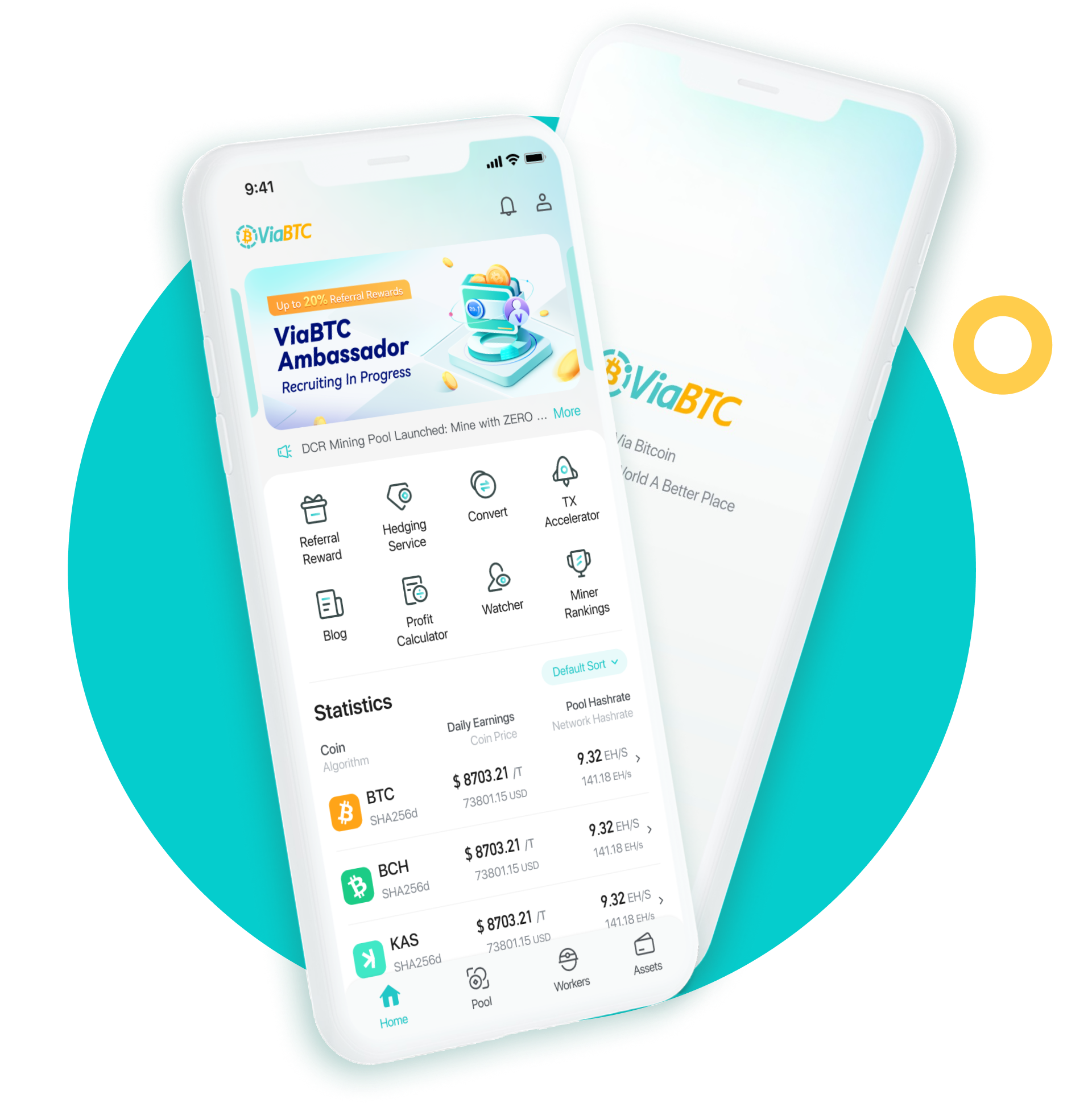
ViaBTC TX Accelerator helps Bitcoin users move an already-broadcast transaction toward confirmation when low fees or mempool congestion leave it waiting. The free service accepts transactions up to 0.5 KB with a fee rate of at least 0.0001 BTC/KB, while the paid service supports BTC, BCH, and LTC for payment. In 2026, ViaBTC’s BTC pool has operated at roughly 90–100 EH/s at different reporting points, giving the service a direct connection to block production rather than simple transaction rebroadcasting. Its main benefit is miner-side prioritization without requiring the sender to create and broadcast the same payment again.
A Bitcoin transaction normally enters the mempool before a miner places it in a block. Bitcoin targets an average block interval of about 10 minutes, but that figure is an average rather than a deadline. A transaction can remain pending across many blocks when its fee rate is below competing transactions. Since the 2024 Bitcoin halving reduced the block subsidy from 6.25 BTC to 3.125 BTC, transaction fees have also remained an important part of miner revenue.
Miners generally build block templates from transactions that make efficient use of limited block space. Fee rate therefore matters more than the absolute fee alone. A 300-byte transaction paying a relatively good number of satoshis per virtual byte can rank ahead of a larger transaction whose total fee is higher but whose fee rate is lower. When demand rises, the queue changes as new transactions arrive, so a payment that looked adequately priced 20 minutes earlier may later sit behind higher-fee transactions.
ViaBTC approaches that waiting problem from the mining side. Its free accelerator accepts a TXID and, after successful submission, gives the transaction priority for inclusion in a block mined by ViaBTC. The official service currently sets the free transaction-size ceiling at 0.5 KB and requires at least 0.0001 BTC/KB in transaction fees. ViaBTC’s May 2024 Help Center documentation previously described 20 free acceleration slots per hour, while the live service now presents availability as a real-time quota.
Free acceleration is not simply a second broadcast. An accepted transaction is placed into ViaBTC’s priority handling process for a future block produced by the pool.
That difference matters because rebroadcasting and mining priority solve different problems. Rebroadcasting helps when a transaction has not propagated well across Bitcoin nodes. It does little when miners already see the transaction but leave it behind because its fee rate is not competitive. A mining pool can alter which transactions it selects for the block template it constructs. ViaBTC’s reported BTC pool hashrate was around 98.79 EH/s on its statistics page in 2026, compared with a network rate above 900 EH/s at the same reporting period.
The relationship between pool hashrate and confirmation is probabilistic rather than fixed. A pool controlling roughly 10% of network hashrate would, over a sufficiently long period, be expected to find approximately 10% of blocks, although short-term results can differ considerably. ViaBTC reported 3-day, 7-day, and 30-day pool-luck figures around 98.44%, 91.05%, and 92.02% respectively at one 2026 snapshot, showing why no accelerator can truthfully promise an exact block time.
That uncertainty is one reason the paid service is different from a simple “next block” guarantee. ViaBTC’s May 2024 support documentation states that after the acceleration fee is received, cooperative mining pools can be notified. When a participating pool finds a block, it can take the accelerated transaction from the pending transaction pool and prioritize it for packaging. The live product page confirms that paid acceleration begins after the service fee is received.
| Service route | Main conditions | Payment | Suitable situation |
|---|---|---|---|
| Free submission | ≤0.5 KB and ≥0.0001 BTC/KB | No acceleration charge | Small eligible transaction when quota is open |
| Paid service | Fee quoted after TXID review | BTC, BCH, or LTC | More urgent transaction or unavailable free quota |
| Normal waiting | No accelerator requirement | Original miner fee only | No time pressure |
| Wallet fee bump | Wallet and transaction must support it | Additional miner fee | Sender can modify or extend the fee structure |
The paid route can also be easier for users whose wallets do not provide convenient fee-management tools. Replace-by-Fee, usually called RBF, can replace an eligible unconfirmed transaction with another version paying a higher fee. Child-Pays-for-Parent, or CPFP, uses a high-fee child transaction to make miners interested in confirming a low-fee parent and child together. Both methods are established Bitcoin techniques, but their availability depends on wallet support, transaction flags, output control, and transaction structure.
An accelerator avoids several of those requirements because the original TXID remains the item being processed. A sender does not need to create a second version merely to submit an acceleration request. That can reduce operational errors for users dealing with exchange withdrawals, merchant payments, treasury transfers, or wallet-to-wallet transfers. In 2026, Bitcoin’s circulating supply had passed 20 million BTC, while the protocol’s maximum supply remains 21 million BTC, supporting a large settlement network in which confirmation timing can matter for both retail and professional transfers.
There are still cases in which the free service will reject a valid transaction. ViaBTC lists four common reasons: the fee rate is below 0.0001 BTC/KB, the transaction is larger than 0.5 KB, the free quota has already been used, or the transaction spends an output from another transaction that is still unconfirmed. Double-spend transactions are also excluded. The parent-transaction rule deserves attention because accelerating a child does not remove its dependency on an unconfirmed parent.
For example, suppose Transaction A pays an address and Transaction B immediately spends one of A’s outputs. If A has zero confirmations, B cannot become independently confirmed before its input exists on-chain. ViaBTC therefore recommends dealing with the earlier transaction first or considering paid acceleration. Since Bitcoin introduced its current UTXO-based transaction model with the network’s 2009 launch, transaction dependencies have always been part of block validation rather than an accelerator-specific restriction.
A TXID should be checked in a block explorer before paying for acceleration. The user should confirm that it is unconfirmed, that the ID is correct, and that the delay is not simply an interface or exchange-account update.
Cost is another reason to compare acceleration with ordinary waiting. ViaBTC does not publish one permanent flat charge for every paid transaction. The platform estimates the acceleration fee after the TXID is entered, and its documentation says pricing can reflect transaction characteristics and current market conditions. Payment can be made with BTC, BCH, or LTC. Once an acceleration request has been submitted, ViaBTC states that it cannot be canceled and the service is non-refundable.
For a $50 personal transfer, paying a sizeable acceleration charge may make little financial sense if the recipient can wait several hours. For a $50,000 exchange deposit needed before a trading or settlement deadline, the same service charge may be easier to justify. The appropriate comparison is not “free versus paid” alone; users should compare the accelerator charge with the likely miner fee needed for RBF or CPFP and with the cost of waiting.
Mining infrastructure also separates ViaBTC from websites that use “accelerator” as a marketing label while only rebroadcasting transactions. The ViaBTC Mining Pool publishes BTC pool statistics, Stratum connection information, mining methods, network data, and pool hashrate. In September 2026, ViaBTC’s public BTC figures showed pool hashrate above 90 EH/s, while Bitcoin network hashrate was above 900 EH/s. Those numbers change continuously as miners connect, disconnect, and redirect SHA-256 computing power.
ViaBTC also supports established BTC mining payout structures. Its 2026 documentation lists PPS+ and PPLNS for Bitcoin mining. Under PPS+, the published pool fee is 4% for the block-reward component and 2% for transaction-fee calculations; PPLNS is listed with a 2% fee. The same mining operation that receives shares from miners and constructs block templates is therefore connected to the infrastructure used to prioritize accepted accelerator transactions.
The free accelerator is most useful when three conditions line up: the transaction is already visible on the Bitcoin network, it meets the 0.5 KB and 0.0001 BTC/KB thresholds, and free capacity is available. A transaction outside those limits may still be a candidate for paid acceleration, but the fee quote should be compared with wallet-based alternatives before payment.
Network conditions should also be checked before spending anything. Bitcoin produces roughly 144 blocks per day when the 10-minute average interval holds, so a temporary mempool backlog can clear naturally if incoming transaction demand falls. A user who has already waited six blocks may decide another hour is acceptable; a merchant waiting to release a high-priced order may use a different threshold. Acceleration changes transaction priority, not Bitcoin’s block-production schedule.
A successful submission also cannot override Bitcoin consensus rules. Invalid signatures, nonexistent inputs, prohibited double spends, or other invalid transaction data will not become valid because an accelerator receives the TXID. Similarly, an unconfirmed dependency still has to be resolved in the correct order. Bitcoin nodes have enforced transaction and block validation rules since 2009, and miners cannot include transactions that fail consensus validation simply because a user pays an acceleration service.
For practical use, the sequence can remain short:
-
Check the TXID in a reputable Bitcoin block explorer and confirm it still has 0 confirmations.
-
Review transaction size, fee rate, and whether any inputs come from unconfirmed transactions.
-
Try free submission when the transaction is no larger than 0.5 KB and its fee rate reaches 0.0001 BTC/KB.
-
Review the quoted paid fee when free capacity is unavailable or the transaction does not qualify.
-
Compare that fee with RBF, CPFP, and simply waiting for the mempool to clear.
-
Recheck the TXID before payment because ViaBTC states that submitted acceleration orders cannot be canceled or refunded.
A user who follows that sequence can choose the least expensive workable route instead of automatically paying more miner fees. During a 2026 period when ViaBTC reported roughly 10% of the Bitcoin network’s displayed hashrate, miner-side prioritization gave eligible transactions access to substantial block-producing capacity while still leaving confirmation timing dependent on which pool finds the next blocks.